They are renowned for creating a delicious golden crisp on your food without unhealthy oils and fats… but are air fryers energy efficient? When the cost of running a kitchen appliance triples due to rising energy bills, examining your air fryer wattage is very important.
This guide will compare air fryers to ovens, slow cookers, microwaves and more, with energy efficiency in mind.
If you are considering buying an air fryer, read this first!
🔑 Key Takeaways
- Air fryers are one of the most energy efficient ways to prepare food
- Air fryers are more energy efficient than ovens (electric, fan and gas),
- Slow cookers, halogen ovens and microwaves are also good energy efficient cooking appliances
- Although air fryers have drawbacks, they can save you a lot of money in energy bills
How Air Fryers Use Energy
Most air fryers rely on convection, which means they create heat that’s then transferred to the food (the opposite is a microwave, which directly heats the food instead of the dish it is in). This, admittedly, is not the most efficient way to cook.
However, the air fryer is small. It has space for a roast chicken, at most, but you can’t fit in multiple dishes like you can with a traditional oven. Most air fryers just have one shelf or basket to place your food in.
This may be inconvenient, but it’s what makes the air fryer so energy efficient. The air fryer uses a fan to blast hot air around the food at a very high temperature. This gives it that toasty brown colour and enables you to cook food super fast.
The biggest drawbacks are that it’s unsuitable for cooking large meals (limited space) and only certain foods can be fried in it (no wet batters).
With that in mind, is the air fryer better or worse than other cooking appliances? Let’s compare to find out.
Air Fryer Energy Consumption
To begin comparing energy consumption for each kitchen appliance, look at how many watts each device uses when it’s cooking your food.
It’s a great way to weed out the totally inefficient devices (gas oven, we’re looking at you), but remember that the method in which they cook is also important.
| Device | Energy Consumption | Cooking Method | Energy Loss | Energy Efficiency |
| Air Fryer | 1300W1 | Blasting hot air – uses a simple heat element and fan. | No – skip preheating, excellent insulation. | Excellent |
| Electric Oven | 2500W | Uses electricity to power a heating element that warms the oven space. | Yes – preheating times and large space to heat up. | Good |
| Gas Oven | 5800W (converting British Thermal Units to watts) | Igniting gas to heat the oven space (still requires electricity too). | Yes – preheating times and large space to heat up. | Okay |
| Halogen Oven | 1200W | Halogen bulb (containing halogen gas) creates heat. | Minimal – preheating takes as little as 2 minutes. | Excellent |
| Convection Oven (Fan Oven) | 800W1 | Uses electricity irregularly, using the fan to move hot air around. | Yes – preheating times and large space to heat up. | Very Good |
| Slow Cooker | 130W | Electrical heating elements at a low power, and a lot of insulation. | No – extremely well insulated and no preheating. | Good |
| Microwave | 900W | Fires microwaves to vibrate food molecules, thus heating them up. | None! Food is heated directly. | Excellent |
| Deep Fryer | 2500W1 | Powerful electrical heat elements bring cooking oil up to temperature. | Yes – every time you take the lid off. | Okay |
Air Fryer vs Oven
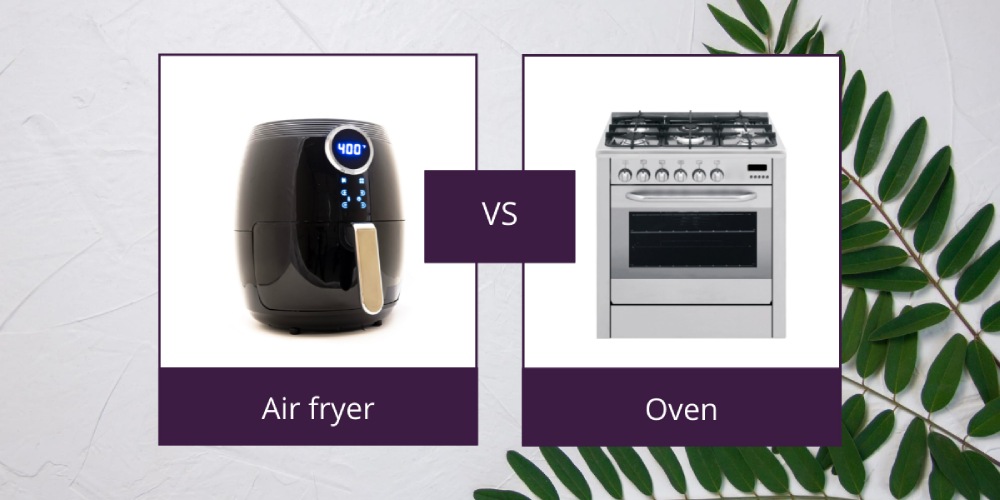
Overall, the air fryer tends to be more energy efficient. This is for a few reasons:
- No energy wasted pre-heating it
- The space that’s heated is very small, while the oven has a lot of empty space to heat up (wasted energy)
- The air fryer reaches high temperatures quickly and cooks your food much faster
The speed and lack of preheating makes the air fryer more energy efficient. Using oven chips as an example, they will take 20 to 25 minutes in the oven (plus preheating time) or 15 to 17 minutes in the air fryer (no preheating time).
The Exception: when it comes to cooking vast quantities of food, the air fryer is inefficient due to its size. You can manage a whole roast chicken, roast potatoes, and Yorkshire puddings in one oven… but the air fryer will need to be used multiple times to manage it all. When you are forced to cook in batches to use the air fryer to feed a large family, it is inefficient.
Now let’s take a closer look at how the air fryer compares to specific oven types.
Air Fryer vs Electric Oven
The standard electric oven (for an electric fan oven, keep scrolling) has a pretty high wattage. Even the most modern electric ovens with great insulation and energy saving designs, are still beastly when it comes to electricity usage.
A regular oven uses around 2500W and operates at full power to preheat and then cook your food.
For all the reasons listed above, an air fryer is much more energy efficient than a traditional electric oven.
Air Fryer vs Gas Oven
Traditionally, gas oven costs in the UK have been lesser than electricity. So, even though the amount of energy used was greatly higher (we converted gas burning, measured in British Thermal Units, to watts for a clearer comparison), the cost was relatively low.
Of course, Russia has since turned off the tap and a gas oven no longer looks like a viable option!
Gas ovens have never been sustainable – they burn fossil fuels for heat, rather than use electricity which could be sustainably sourced. Add onto this the inefficiency of large ovens, preheating, and unavoidable heat loss… it is just a bad idea.
Air fryers are way more energy efficient than gas ovens. A gas oven should be a last resort.
Air Fryer vs Halogen Oven
Halogen ovens are incredibly energy efficient. Along with the air fryer and slow cooker, they are excellent for producing small meals with very little energy.
In our article Halogen Ovens, Everything You Should Know, we discovered that a halogen oven typically cooks food three times faster than a traditional oven!
As for energy consumption, the wattage is very similar to air fryers. The key difference between the devices is that the air fryer uses convection and a fan to heat the food, while the halogen oven uses a halogen bulb.
As a result, the halogen oven doesn’t “fry” or create a good crisp finish. It is great for baking, however, and is almost as energy efficient as the air fryer despite needing a minute or two to pre-heat.
Air Fryer vs Convection Oven (Fan)
The fan oven is one of the more energy efficient oven types. Rather than using full power to maintain heat, it switches on and off in a cycle – the average power consumption is around 800W as a result.
The fan moves the heat around the oven space, ensuring an even temperature for your food. Only when the temperature drops too low will the heating element power back up to keep it steady.
Again, you have the downfalls of all large ovens – preheating times and a large space heated for a small amount of food. Even though fan ovens have low wattage, the air fryer remains more efficient due to the speed in which it cooks.
Air Fryer vs Other Cooking Methods
Air Fryer vs Slow Cooker
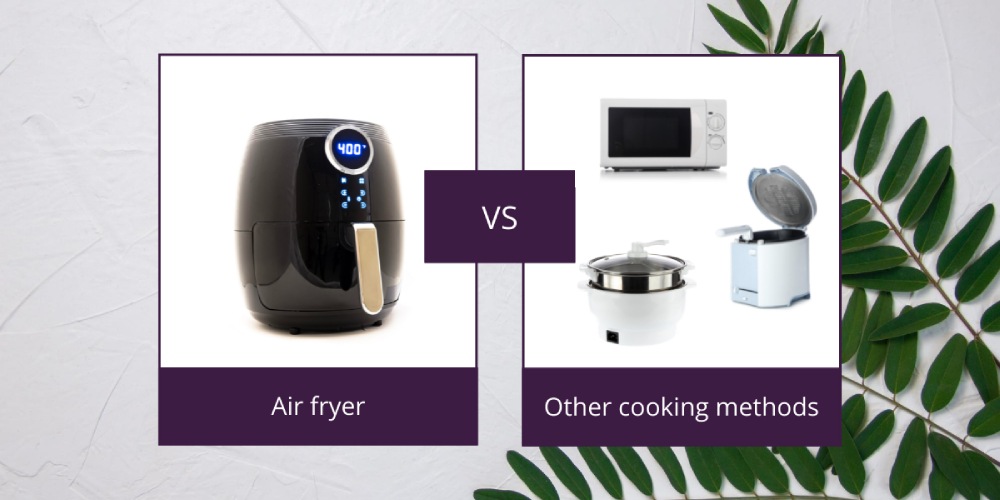
Slow cookers use very low energy levels – around the same levels as a lightbulb. So, if you used a slow cooker for 20 minutes and an air fryer for 20 minutes, the slow cooker would be miles more efficient…
…but your food would be raw.
The slow cooker is designed to cook at a low temperature for a very long period. Although the average slow cooker uses between 100W and 160W, if you use it for 10 hours, it’s actually not going to be hugely more efficient than the super fast air fryer.
Exactly how much more efficient the slow cooker is, depends on your recipe timings. Use our formula below to calculate how much energy is used.
Air Fryer vs Microwave
Both the air fryer and the microwave are super fast. Most microwave ovens fall between 600W and 1200W in the UK. You can also heat up a bowl of soup in just 3 minutes, using microwaves to directly heat the food molecules (direct heating = no energy lost).
So, the microwave is an incredibly energy efficient way to heat up food… but it’s not really a fair comparison.
Just like the air fryer is limited to baking and frying foods, the microwave can’t saute onions or slow roast a pork tenderloin.
So, if your food can be heated (or reheated) in the microwave, it’s the most efficient choice. But obviously for cooking foods from scratch, the air fryer is a more versatile option.
Air Fryer vs Deep Fryer
A deep fryer can use anywhere from 1000W to 5000W! Even though you cannot beat the delicious crunch of foods prepared in a deep fryer, we don’t think it is worth it. The air fryer also does an excellent job but with no preheating, no energy loss, and a lower wattage on average.
The biggest problem with the deep fryer is that you cannot fry with the lid on. An air fryer is contained while it “fries” and thus all the heat is trapped in. With a deep fryer, you need the lid to be off so you quickly remove your chips (or Mars bar). When the lid is off, you are effectively trying to heat up the room as well as the oil.
Once you add the cost of your oil to the energy used for a deep fryer, it’s wildly inefficient. Save the deep fryer for special occasions, and go for the highly efficient air fryer.
So, What Are The Total Air Fryer Costs?
With energy bills rising by thousands of pounds, giving you an exact figure is pointless. It will be outdated by next week!
Luckily, it’s pretty easy to work out how much your cooking appliance will cost you. To work out how much the air fryer will cost you in energy bills, use this formula:
- Wattage of the device x number of hours used = watt-hours consumed
- Watt-hours ÷ 1,000 = kWh consumed
- kWh consumed x electricity rate = the cost of using the device!
Air Fryer vs Oven Cost Example
| Air fryer | Electric oven | |
| Average wattage | 1300W | 2500W |
| Cooking time | 30 min | 40 min (10 min preheat) |
| Watt-hours consumed | 650 | 1667 |
| kWh consumed | 0.65kWh | 1.67kWh |
| One meal cost | £0.34 | £0.87 |
| Monthly cost (estimate) | £10 | £25 |
An air fryer at 1300W, used for 30 minutes (0.5 hours) equals 650 watt-hours consumed.
650 watt-hours divided by 1,000 equals 0.65kWh.
0.65kWh times £0.52 (predicted UK electricity rate for winter 2022) equals £0.34.
Now for the electric oven, we have the same formula but add 10 minutes to preheat it (40 minutes total) and calculate the wattage at 2500W. The resulting cost is £0.87.
It doesn’t sound like much when you compare one meal, but a month of dinners cooked in an air fryer costs just over £10 while the electric oven costs over £25.
Air Fryers – FAQs
The average air fryer uses around 1300W, which is less than most traditional ovens. As air fryers don’t need to be preheated and offer a shorter cooking time, they have higher energy efficiency too.
In the UK, with rising energy prices, every cooking method is becoming expensive. Appliances that use minimal electricity and no additional fuels (e.g. gas for an oven or oil for a deep fryer) are the least expensive. Air frying is definitely one of the least expensive cooking methods!
Both an air fryer and an electrical oven (fan or standard) use electricity to power a heating element that warms up a space. The difference is that the air fryer uses a much smaller space and a heating element that uses less electricity. As a result, less electricity is used to cook the food. It also doesn’t need time to preheat and cooks way faster than the oven, so it’s more efficient all-round.
The only drawback, however, is that the air fryer is limited in capabilities and won’t be big enough to serve a large family.