The economy is never a light, cheerful topic, let’s be honest.
After years of greying old men in suits talking about it in the news, it’s hard to be invigorated by a chat about the economy.
But this article about circular economy is going to change that.
Circular economy is an interesting system that’s designed to tackle some of the greatest challenges of our time, particularly when it comes to reducing environmental impacts. And it’s not a fringe movement either – the EU’s new circular action plan has just come into effect in 2021.
How can a circular approach be the key to solving the climate emergency? Let’s find out.
What is a circular economy?
Before we dig into our circular economy definition, let’s just make certain that we know what an economy is.
Economy [noun]: the relationship between production, trade and the supply of money in a particular country or region.
The economy is all about producing items, trading and selling them, and earning money from this. When production and purchasing are on the up, you might say “this is a boost to the economy” for example.
So, a circular economy turns this relationship into a closed-loop system. Instead of producing and trading items just to see them eventually end in landfill, a circular economy employs reusing, repairing, remanufacturing, and recycling tactics.
As a result, a circular economy reduces waste (aiming for zero waste) and pollution to take on global challenges such as loss in biodiversity and climate change.
Circular economy VS linear economy
We are currently living in a linear economy.
We harvest raw materials (e.g. oil), make it into products (e.g. single-use plastic bottles), sell them for money (of course), then forget about them (e.g. send them to landfill).
A linear economy has a set start point and a set end. From the natural world to landfills. It creates waste and pollution, we all make money, and then it starts from the beginning again.
So the main difference between linear vs circular economies is that one is unsustainable and wasteful, while the other is regenerative and productive.
The 3 key circular economy principles
Circular economy aims to change the way we live and the structure of our communities for good. So, what are the key elements of circular economy?
1. No more waste or pollution
The biggest principle of circular economy is ‘zero waste’. This principle is all about changing how we make things. Products should be designed to last, rather than eventually break over time (or need upgrading, like your iPhone). They should also be made with eco-friendly materials and processes, wherever possible, to reduce pollution.
Planned obsolescence is the mortal enemy of circularity.
Every product should be designed to be reused, renewed, fixed, or transformed into something else. Meanwhile, recycling should be a last resort because it requires a waste of energy and resources.
2. Regenerate the natural world
The products we use and the way we dispose of them should enhance the natural world, not squash it. This is done through biological cycles and technical cycles.
Biological cycle example – harvesting potatoes only when they’re in season, then composting the food waste to renew the earth for next season.
Technical cycle example – an old, broken washing machine should be fixed if possible, working parts should be salvaged, and renewed or updated instead of disposed of.
This principle is all about optimising how we use materials. It’s highly efficient – instead of using a material once or creating a lot of waste, it is reused or repurposed to benefit the environment.
3. Enhance renewables and decrease resource dependence
Creating a circular economy and powering all of these new fixing and remanufacturing schemes requires energy. But circular economy has a plan for this too.
Instead of building these schemes and systems on traditional energy (e.g. hooking them up to the power grid and burning fossil fuels to power them) they should be powered with renewable energy… from the start.
Circularity plans to be powered by renewables from the very first step they take, rather than phasing it in later.
Understand the circular economy
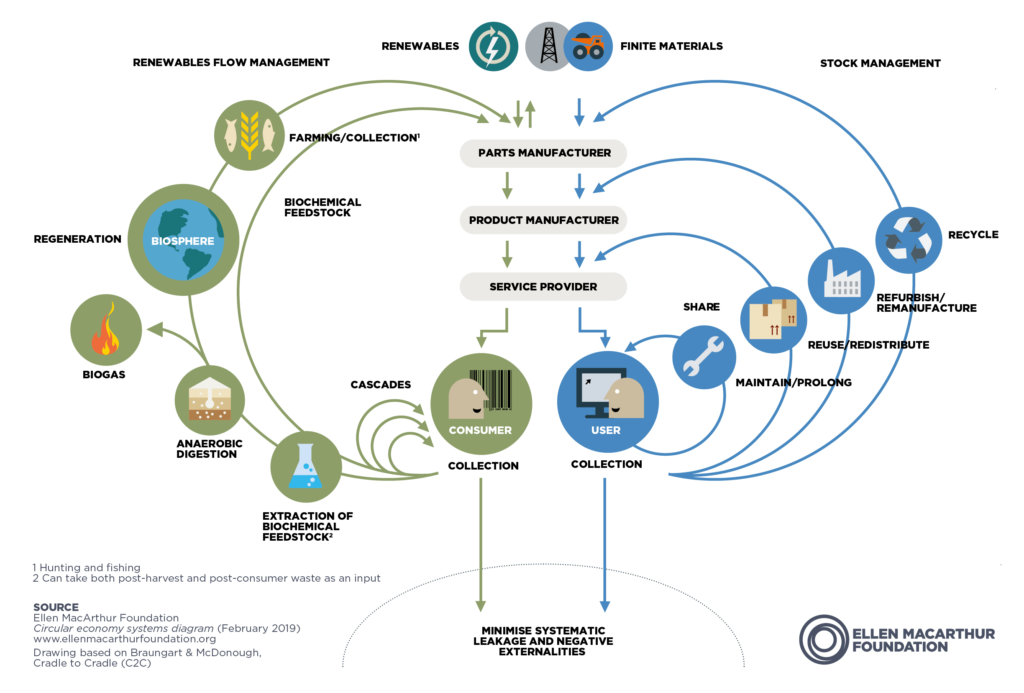
The Ellen Macarthur Foundation is a registered charity with the aim to “accelerate the transition to a circular economy”. They’re the experts in this field and they’ve created the best circular economy diagram we’ve seen for circularity and how it works.
Feast your eyes on this.
A good circular economy example
One great example of a circular economy in action is an investment firm called Closed Loop Partners. This business innovates and invests in companies to help them create a circular economy.
In an interview with Sap Insights, CEO Ron Gonen gave a brilliant example of how it can work for a company:
“Algramo sells name-brand household cleaning products in bulk from cashless kiosks using reusable containers with an embedded radio-frequency identification (RFID) chip that connects to the online payment capabilities of your mobile phone. You download the Algramo app and create an account, then go to the vending kiosk, where you select an Algramo “smart” container and fill it with detergent. The kiosk charges you for the product by weight and deducts that plus the cost of the container from your account. The next time you run out of detergent, you bring the container back to the kiosk, which charges you only for the refill. And you don’t have to fill the container to the brim. You can buy only as much as you need or can afford.”
This example is great for a few reasons:
- It encourages customers to use the same container over and over, reducing single-use plastic,
- Customers only need to buy the volume they need, reducing waste further,
- Packaging waste is reduced for the company, which also increases their profit margins as they no longer need to spend so much on packaging materials,
- The use of technology to track the economy (how much is purchased and for what cost) allows for much better inventory management,
- The business can track which repeat customers are most loyal and their shopping habits, so providing discounts and effective marketing becomes so much easier.
We love this example of circular economy because it shows how it will benefit everyone – the customer, the business, and the environment – and it’s very applicable to your life!
This is an example that you can get involved with now. Check out our list of loose food shops in the UK to get started.
Circular economy transition – how it works
Transitioning from our current linear economy to a fully circular economy is a massive undertaking. Here’s how the experts in circular economy at the World Resources Institute believe the transition will work:
Systemic change
Before we look at what we can do on an individual level, it’s important to understand that changing the economy and how the entire system works needs to be done from the top.
Systemic changes to industry policy need to happen so that choosing sustainable, circular products isn’t a choice that the consumer has to make. It should be the automatic option for everyone.
Governments are beginning to do this through waste legislation and targeted taxes, e.g. the UK’s planned plastic tax for 2022 which taxes all plastic packaging that is made from less than 30% recycled plastic.
Consumer changes
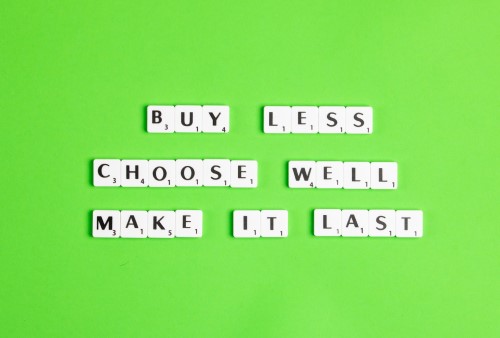
The first big consumer change that needs to happen, is for consumers to consume less. It’s not going to be an easy change, for us or businesses, but it is essential.
To rely on natural resources, we can’t over-consume. No more binge-eating or buying more than we can use. For businesses, this is going to be a huge change in mindset, as most business plans work on the concept of “the more people buy from us, the better”.
Once we’re consuming less, we then need to consume better. This applies to everything we buy – we need to select the more sustainable option. But don’t think of this as a downgrade! For example, listening to all your music from one device (your phone) is a lot more efficient than having all your music on CDs like in the 90s.
Pros and cons of circular economy
Like any economy, circularity isn’t without faults. As the Ellen Macarthur Foundation so brilliantly put it in their Instagram update, the messy reality of circularity is, well, circular-ish.
But hey, Rome wasn’t built in a day..
What are the disadvantages of circular economy?
Let’s get the negatives out of the way.
- It means consuming less and making sacrifices as a consumer
- Prices will go up – initial investments are required to kickstart circular economy and produce long-lasting products with higher quality materials
- It’s not clear how a circular economy can cope with unpredictable events. The COVID-19 pandemic, for example, has required an incredibly vast number of single-use masks and other protective wear that cannot be reused
- Current circularity models are over-simplified and the idea that it will boost sustainability is mostly still a theory – with minimal real-world uptake, researchers are struggling to quantify and predict just how much the circularity concept will work with sustainability. They have concluded that “Despite often being used in similar contexts, the similarities and differences between these concepts have not been made explicit in the literature, therefore blurring their conceptual contours and constraining the efficacy of their use.“
- True, total circular economies require innovation, new technology and processes that may not exist yet
What are the benefits of a circular economy?
The benefits, in our opinion, far outweigh those negative disadvantages.
- Numerous environmental benefits – improved soil health, reduction in water, air and land pollution… all of which should reduce climate change and encourage biodiversity
- Consumers can save money in the long-term. Modular products that can be disassembled, repaired and reused save us money
- Economic growth will rely on circular activities (repair shops, etc.) rather than natural resource consumption to create new products
- New jobs and niches created – designers who can innovate circular products, repair specialists to fix broken products, and recycling plant operators to recycle unusable materials
- The boundaries of our technology will be pushed, as we innovate new tech to improve efficiency and enable true circularity
- Companies will be more resilient with a reliable supply chain for materials. They won’t need to rely on the costs of natural, virgin materials, which can be volatile and susceptible to geopolitical crises
How circular enables sustainable consumption and production
A circular economy and sustainability principles are clearly entwined. Both aim to reduce the use of natural resources, prevent waste, and provide a better quality of life for us without sacrificing the planet.
But there are some other concepts of circularity that enable sustainable consumption and production too.
One example is the lease business model. This aspect of a circular economy is all about sharing, renting and leasing products instead of buying them. For example, you may buy an electric power drill and other tools to put up shelves and do a little DIY one year… but then these products sit in the loft for decades. A lease circular business would allow you to return those tools once you’ve used them and they’ll be sent to someone else.
This also applies to more frequently used products, like your lawn mower. You mow the lawn once a week, just like all your other neighbours. So why not buy one lawn mower between 7 households and each uses it one day a week on a rotation?
As we introduce a circular economy into our societies, businesses and organisations will need to innovate solutions like these to stay within the government’s circular economy guidelines and meet customer’s sustainability goals.
Mindset change: circular thinking
The biggest challenge we face between a linear economy and a circular economy is the way we think. This applies to businesses and how they define success, as well as governments and what their priorities are when creating new policies.
Importantly, it also applies to you. A circular economy requires everyone to participate. Recycling, reusing, and consuming sustainably are concepts that you’ll need to take on board.
To get started and really make a difference, you can start with guide to sustainable consumption.