Eco-economic decoupling sounds like UN jargon for a complex environmental policy. But actually, it’s quite a simple concept to get your head around. When implemented, the results of decoupling could be pretty impressive too!
As always, there are significant challenges between the human race, decoupling, and a healthy planet. Decoupling is promising, but it has some loopholes. The simplicity of the concept itself could be a major stumbling block.
So, should we give decoupling a try? Let’s find out.
What is Decoupling Economic Growth?

When something is coupled, it means that they are linked. If one component grows, then so does the other. If it drops, the other falls with it.
Decoupling means breaking this link, so one component could grow while the other declines.
Ecological-economic decoupling is about breaking the link between economic growth and environmental degradation.
In a perfect world, decoupling ensures that our economies can continue to prosper, while environmental pressure drops. That means less resource consumption, fewer emissions, a healthier planet, and a thriving human race.
One of the SCP Practices
Decoupling is one of several practices aiming to improve sustainability, quality of life, and the environment to halt and reverse climate change. Eco-economic decoupling is focused on the economy and economic output, while other practices for sustainable consumption and production (SCP) focus on efficiency, technological advances, mindsets, and product lifecycles.
Learn more about sustainable consumption and production, or get your feet wet with other fascinating concepts that could help save the world:
- Environmental Leapfrogging
- Life Cycle Thinking
- Circular Economy
- Eco-efficiency
The European Green Deal
Decoupling is a key component of the European Green Deal. This “Deal” is all about turning the EU into a modern and sustainable economy, where GDP growth isn’t linked tightly to resource use.
The goals of the European Green Deal include:
- Zero net carbon emissions
- Equality between all countries – no developing country left behind
- Prevent climate change and environmental degradation
The overall aim is to make Europe entirely climate neutral by 2050!
How We Measure Decoupling Efficiency

If it was as easy as snapping our fingers and decoupling the economy, we would have done it by now.
Unfortunately, it’s incredibly difficult to go about decoupling.
There are ways that we can isolate parts of an economy and decouple them (more on this partial decoupling below) but we still need a way to measure the impact.
This is where the phrases resource decoupling and impact decoupling come into play.
Resource Decoupling
Measuring economic growth is a tricky task. Usually, actual growth is measured through gross domestic product (GDP) – this is the combined monetary value of all the products and services created in a specific time frame.
If someone said the GDP is down this year, that means the economy is smaller than the previous year.
Obviously, to make products and services, resources must be used. That’s how the economy and resource extraction are linked.
So, resource decoupling measures the rate of resources used per unit of economic growth. Successful decoupling should see fewer resources used even when the GDP rises.
Impact Decoupling
Impact decoupling is different to resource decoupling. In fact, impact decoupling encompasses resource decoupling with a focus on breaking the link between the economy and environmental harm.
Instead of just looking at the link between resources and the economy, impact decoupling measures how economic growth and decreased resource consumption impact the environment.
This is really important because it gives us the bigger picture.
An Example of Resource vs Impact Decoupling
Resource decoupling might reveal that by banning plastic carrying bags for packing groceries, supermarkets have reduced plastic consumption while still boosting profits. The “economy” of the supermarket is no longer linked to this resource.
However, impact decoupling could then reveal that overall, single-use plastics used in supermarkets are still causing a huge impact (even without the plastic carrying bags) and combined with an increasing population, the overall negative impact on the environment is continuing to grow.

Dimensions of Decoupling
When it comes to decoupling, there are many different dimensions. These different dimensions are worth learning about, so you can see what decoupling actually works and what is just greenwashing.
Relative Decoupling vs Absolute Decoupling
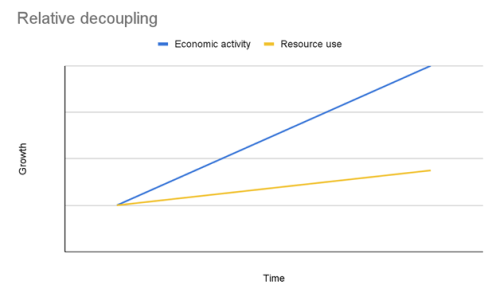
Relative decoupling sees both the economy and resource consumption increase, but at different rates. So, instead of parallel lines on a graph, we see a widening gap. The economy increases a lot, while the rate of consumption increases only a little.
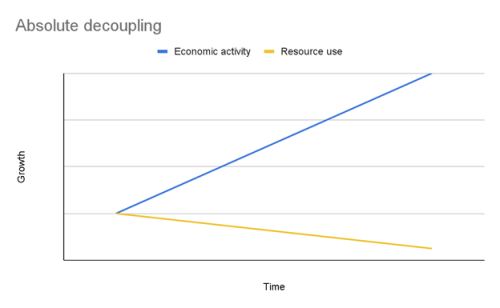
Decoupling unhooks resource consumption from economic growth, but don’t forget this also applies to pollution, carbon emissions, and any other byproduct created. To achieve absolute decoupling, everything needs to be in decline.
With absolute decoupling, as the economy grows, resource consumption drops. The lines are shooting off in opposite directions.
Overall vs Partial
Economies are complex. There’s the world economy, where the economies of individual regions interact, and then there’s separate economies for each country, where business and politics rule.
Implementing decoupling on a small part of an economy is much more achievable, but it has minimal impact in the grand scheme of things.
Partial decoupling will only impact a few metrics. Overall decoupling impacts the whole system.
Furthermore, partial decoupling can sometimes seem like overall decoupling, when in fact it’s just substituting one problem for another.
As The Conversation explains;
Substituting carbon-intensive energy with cleaner, or even carbon-neutral, energy does not free our economies of their dependence on finite resources.
Permanent vs Temporary
This is self-explanatory. Some decoupling is permanent, some is temporary. For example, during the COVID-19 pandemic, many workers decided to stay at home and work remotely. Work output remained level(ish) while commuter emissions dropped considerably. Now, however, this decoupling is starting to reverse. It was a temporary change.
The EEB Decoupling Debunked paper gives an example of how temporary decoupling can rebound partially or totally with energy efficiency.
Partial rebound: a new heater consumes 50% less energy but rebounds in being used 1.5 times more than the old one, which means there are still 25% net savings overall.
Total rebound: you manage to save money by driving a car that consumes 30% less energy per km… but then you use that money to pay for a holiday trip by plane; you’ve “rebounded” the entirety of the impact decoupling through air travel emissions.
Global vs Local
As humans, we may have split the world into continents and regions, but the environment doesn’t play by our rules.
Local decoupling may reduce some environmental impact, but on a global scale, it’s irrelevant if other areas are continuing their consumption and pollution. In the worst cases, it can shift the responsibility from a developed country to a developing one. On the other hand, local decoupling in the UK could have a large environmental impact halfway around the world.
Tea drinking, for example. 68% of the UK population drinks tea every day, but our tea is grown and produced in China, India, and Kenya (among other countries). Decoupling our tea consumption locally could therefore have a global impact.
Fast vs Slow
It’s true that we need a fast solution, as our natural resources are running out rather quickly. But both fast and slow decoupling come with drawbacks.
Fast decoupling runs the risk of a rebound, and it also encourages partial decoupling.
On the other hand, slow decoupling gives us time to implement a long-lasting framework and plan for any rebound that may occur. But of course, we may not always have the luxury of taking things slowly!
Challenges Before Us and the Environment

If we want to make global, permanent and overall decoupling a reality, there are some hurdles to jump over first.
Consumption = Wellbeing?
As the EPRS reports;
The countries reporting high scores on life-quality also have a globally unsustainable level of resource use. This is where sufficiency becomes important.
Consumption is coupled with wellbeing, so eco-economic decoupling will undoubtedly impact our wellbeing too. Can humans find value in something more, or somewhere else? Can developing countries improve wellbeing without increasing consumption?
Attitude and Behavioural Choices
This ties closely to environmental leapfrogging for developing countries.
When we think of developing countries becoming developed ones, we often imagine a place where everything is accessible to everyone. Not just healthcare, but iPhones, large houses, 2 cars in the driveway, etc.
This is a problem for decoupling. Maintaining the idea that everything should be accessible to everyone is noble, but we aren’t sure how that is achievable when decoupling the economy.
Would you want to give things up, or deny developing countries these luxuries, to save the planet?
Technological Barriers
Clean energy is key to reducing environmental impact while still allowing us to consume energy and keep the economy moving. Solar paint and quantum thermodynamics are two examples of technologies that we are trying to develop to achieve this.
The problem is, creating and implementing is a challenge, not to mention that it still leaves our economies reliant on energy consumption for growth.
Social Collapse
The concept that change is inevitable, that you should “let nature take its course” and “you can’t make an omelette without breaking eggs” are all clues that sometimes, collapse and disaster is inevitable.
This is the theory that regardless of technological advances and best laid plans, an economical or societal collapse is destined to happen. MIT has even predicted that we’ll face societal collapse by 2050.
Tipping Points
A tipping point is when you’ve passed the point of no return. Some systems degrade slowly over time, while others suddenly drop. This is true of both ecosystems and economic systems. Furthermore, with technological progress over the past century and increased global trade, our system of interdependence is infinitely more complex and delicately balanced.
This makes it really hard for scientists to predict which climate crisis is the most imminent, and where we should focus our decoupling efforts first.
Decoupling Delusions and Lack of Evidence
Do you have faith?
This is an important question for decoupling. As a concept, it hasn’t been proven. In fact, the official Wikipedia entry for decoupling even goes so far as to state:
There is no empirical evidence supporting the existence of an eco-economic decoupling near the scale needed to avoid environmental degradation, and it is unlikely to happen in the future.
Obviously, this is a huge problem. Decoupling is a brilliant idea, but those with a good grasp of the eco-economical status of the world don’t have faith in it.
Decoupling Trends
In contradiction to that last problem, there are several trends that show decoupling in action, or at least where decoupling has been proposed as a viable solution.
- Public Appreciation – the more the public (yes, that’s you) understands decoupling and the impact of our economy on the environment, the more pressure there is on policymakers to make real changes.
- Carbon Emissions Goals – from the European Green Deal to the UN Sustainability Goals, the higher-level organisations in the world are starting to implement some real changes at a governmental level.
- Circular Economy – along with eco-economic decoupling, circular economy is a key concept that environmentalists are pushing for. Although it’s still just a theory, it has been planned out in more detail than decoupling and is worth reading about!
Check out our circular economy explainer article to learn more.